New Privacy Policy Statement

Posted by Colin Baxter, August 2nd 2018 | no comments

As part of the push to be GDPR Compliant as required by EU law, the practice and methods of collecting, processing, and storing personal data have been updated slightly. The protection of personal data has always been a priority, but now the processes are more transparent.

The EDA Expert privacy policy now has a dedicated page. If you use this website in any way, you are encouraged to read this statement. The page is listed in the footer menu, so it is always easy to refer to in the future.

Updates to this statement will occur in the future, and announcements in this blog will be made appropriately.

Here is the link to the privacy policy statment.

Please also note that the cookie policy statement has also been updated, which ties in with the privacy policy statement.

Leave a comment


EDA Weekend Reader – Computer Architecture

Posted by Colin Baxter, November 26th 2016 | no comments

computer architecture

This book, by Robert J. Baron and Lee Higbie, is a great reference book introducing the reader to “an overview of a computer’s key structural building blocks, such as the CPU, I/O, memory, with references to particular architectures such as the IBM PC. The copy was published in 1992, and I purchased this book in 1992 to assist with my studies as a computer systems undergraduate at Warwick University – the cover still has the Warwick University Bookshop price stamp! This book contains lots of problem exercises to go away and tackle!

Contents Review of Computer Architecture by Robert J. Baron and Lee Higbie

The book starts with a bit of history (pre 1992) of computers and their architecture. The classes of architecture are explained: Von Neumann machines and Non-von Neumann machines and how they differ with regard to arthimetic computation and memory access.

The reader is then introduced to the instruction-set architecture. Floating point numbers, data structures, data precision and data types are each discussed with useful diagrams. Registers and instruction types and addressing techniques are then discussed in detail.

The book goes onto the topics of buses, CPUs, I/Os, and memory system architecture. The reader is introduced to the technique of memory caching, the various types of memory caching, and virtual memory.

A real architecture is then applied in the shape of the IBM PC. This may seem dated now with the multi-core processor devices that are used today, but is a great way to see how the various parts of the computer architecture discussed earlier in the book are applied to a real-life subject. Again, lots of useful diagrams here aid the understanding of what is being described.

The remainder of the book discusses in detail the process of pipelining, RISC architectures, and parallel processor techniques. Right at the end of the book in the appendix is a useful reference to various logic parts you will find in computer architectures – multiplexors, demultiplexors, shifters, adders, clock generators, registers, counters, stacks, multipliers.

24 years on, this is still a valued book on my bookshelf, and it is referred to frequently.

Leave a comment


EDA Weekend Reader – Application-Specific Integrated Circuits

Posted by Colin Baxter, October 31st 2016 | no comments

ASICs by Michael John Sebastian Smith
Inside ASICs book

This book, by Michael John Sebastian Smith, is an excellent study book for those interested in all things ASIC (Application Specific Integrated Circuits).

Contents Review of ASICs by Michael John Sebastian Smith

At the start there is an introduction into ASICS (and programmable gate arrays), the different types of ASICS and gate arrays. The all important economics of the devices are considered. The book then moves onto CMOS logic and ASIC library design. Covered are design rules, drive strengths, latches, flip-flops, datapath elements, adders and multiplers.

The book goes into detail of various programmable devices from Xilinx, Altera and Actel. It’s a little dated now to be honest (my copy was published in 1997), but it’s still relevant to today’s technology. Logic synthesis is discussed before the book goes headlong into low-level design languages, VHDL and Verilog HDLs (hardware description languages).

Lots of VHDL and Verilog examples are listed in completeness for the student to read and understand more fully. The hardware description language examples and logic sythesis is described in detail here.

The book then moves onto simulation and its importance in relation to logic sythesis. The importance of formal verification is described too. Finally, SPICE modelling is covered with examples of transistor-level simulation.

The all important ASIC testing is covered next with descriptions of boundary-scan techniques. Also covered are the various circuit faults to expect. The test chapter goes on to ATPG (automatic test-pattern generation), and scan-chain insertion.

Physical attributes of an ASIC are then discussed: system partitioning and power dissipation. The reader is introduced to the various stages of physical design – partitioning, floorplanning, placement and routing. The remainder of the book is taken up with detailed analysis of each of these stages of the ASIC design process.

Concluding Note

This book was used much during my post-graduate studies whilst reading at Bolton University. It is one of most valued books in my collection and spends more time off the shelf than on! The book was opened again this weekend!

Leave a comment


EDA Weekend Reader – IET – The Art Of Electronics

Posted by Colin Baxter, October 17th 2016 | no comments

iet article art of electronics pic 1
iet article art of eletronics pic 2

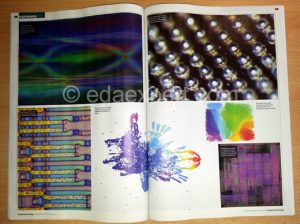
Not much time to read this weekend, but the latest IET Magazine had landed on my doorstep. So some reading matter to enjoy! One article that caught my eye was The Gallery which is entitled The Art of Electronics. The article is by Chris Edwards and clearly illustrates that electronic design can be artistic in a creative sense and not just science and engineering all the time. But electronics is science and engineering of course!

Leave a comment


30 Keyword Phrases That ….. Epitomises Work Experience at Interlink Communications Ltd (Clacton, UK)

Posted by Colin Baxter, October 12th 2016 | no comments

OK, for a bit of fun and personal memory bank testing, here are 30 keyword phrases that epitomises my work experience at print server specialists Interlink Communications Ltd of Clacton on Sea – my first proper post after graduating at Warwick University with my BEng in Computer Systems Engineering – Junior Software Engineer, 1996:

NEC UPD70433

  • NEC Corporation V55PI microprocessor
  • print servers
  • embedded processor
  • x86 family
  • software development
  • Borland Turbo C++
  • RS232C
  • serial port
  • parallel port
  • TCP/IP
  • NetBeui
  • fault finding
  • telephone technical support
  • high-level programming
  • “printer linker”
  • “netpod”
  • firmware
  • coaxial cable
  • RJ-45 cable
  • communication protocols
  • oscilloscope
  • multi-meter
  • 16-bit
  • dotmatrix screen
  • transceiver
  • Turbo C code rewriting
  • Netware
  • SNMP
  • printer queue
  • Windows NT

Leave a comment


EDA Weekend Reader – Mobile Unleashed

Posted by Colin Baxter, October 10th 2016 | no comments

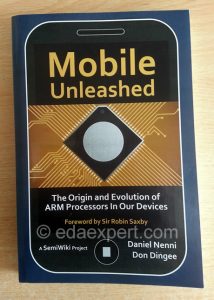
Mobile Unleashed – The Origin and Evolution of ARM Processors In Our Devices

Daniel Nenni & Don Dingee 2015

mobile-unleashed-w460

This is an excellent book detailing the origins of ARM, emerging from the Acorn Computer Company and the educational 6502 BBC Micro to the industry de-facto microprocessing power that exists in the majority of the smartphones around the world. A fascinating read of the twists and turns that the ARM business endured with the various projects detailed – the people involved, the applications targeted, the CMOS technology size, clock frequencies incorporated, even the transistors counts.

How each ARM architecture has evolved is also detailed – caching, pipelining, AMBA, and so on.

Coincidentally, I started computer programming at school in the 1980s and it was on a BBC Micro. It’s where it all began for me too!

A great read over the weekend.

Leave a comment


New Website Launched

Posted by Colin Baxter, October 7th 2016 | no comments

My new EDA website has arrived! It will detail my experiences and personal perspective of all things EDA, from the early days at college working on circuit design assignments using an Apollo mainframe computer to working as an EDA design flow specialist engineer for Philips Semiconductors. Although my career in EDA is on pause, the interest and enthusiasm in all things EDA has not diminished, in fact has been fired up by all the latest developments in recent years.

Many of the pages have not yet been populated with content. This will be rectified in the coming days.

Thanks for your interest.

Leave a comment